
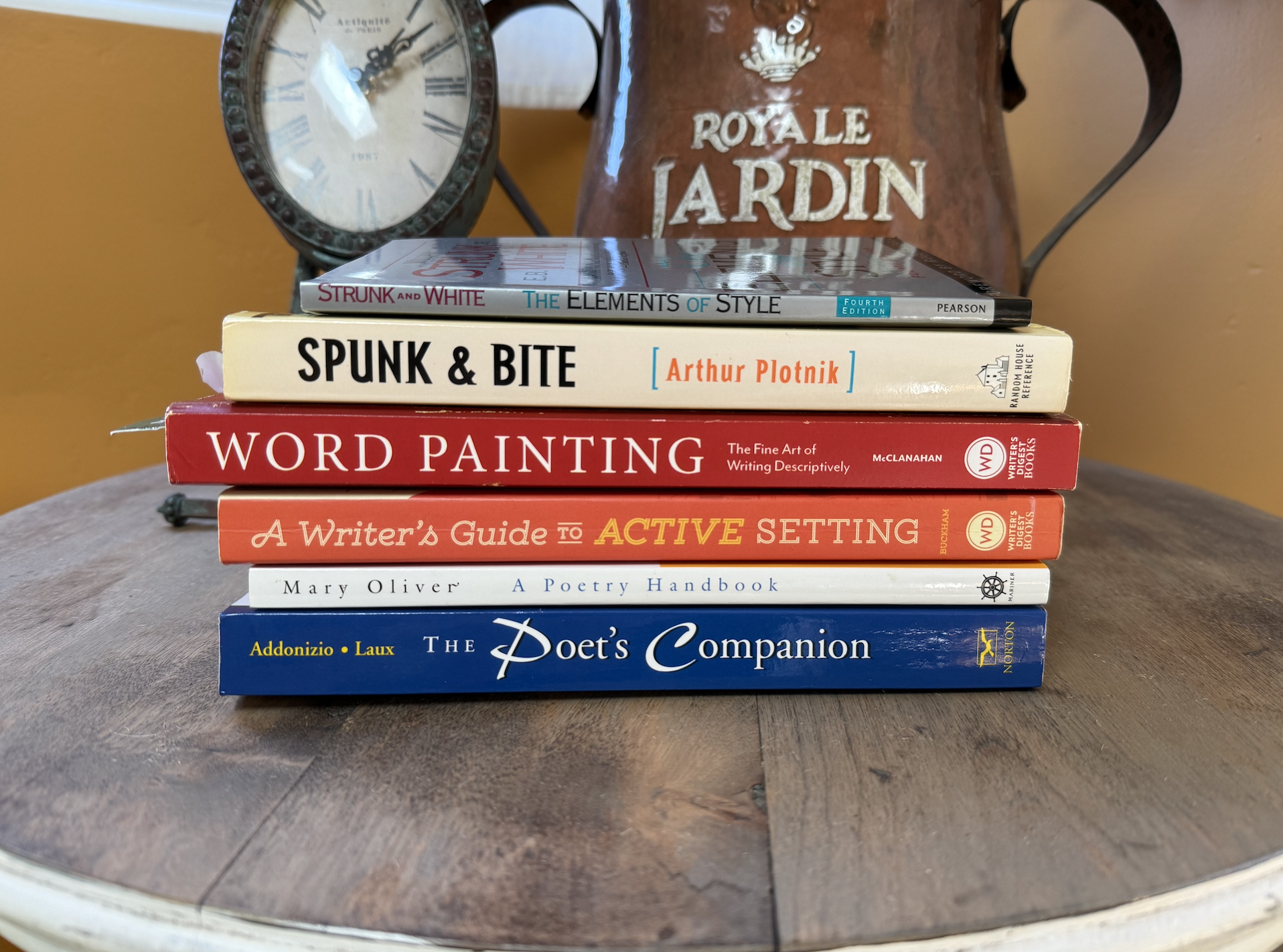
I love a good book on writing craft. The shelf that I can see from my bed consists only of craft books that I anticipate referencing, re-reading, or putting into a list like this one—and typically all three, just to keep my story instincts sharp.
I spend a lot of time reading forums for writers to get a feel for where people struggle, and something that gets brought up a lot and isn’t always well-answered is that a lot of writers want to improve their prose and don’t know how to go about it, or they’re afraid of committing the ‘purple prose’ sin. Online articles probably have them wading through the same tides—eliminate weasel words, go easy on helping and linking verbs, etc etc—and the books included here will include that information, but they also go much, much further. So if you want to improve your prose at the sentence level, then read on.

The Elements of Style by Strunk and White…Then Spunk & Bite by Arthur Plotnik
The best thing you can do to start is familiarize yourself with the basics. That’ll be the reason for the first recommendation—the first half of it, anyway. It’s a small book, around 100 pages, and it goes over basic rules of usage, composition, and form, then touches on commonly misused words and phrases, and then provides a list of reminders when approaching style. You’ll learn the technical terms for parts of speech and you’ll receive some good instruction for writing clearly. Which is important.
Then, you can read Spunk & Bite and read about which of those rules are worth breaking and how to break them effectively and meaningfully. As someone with a background in linguistics, I enjoy seeing this book taking the prescriptivist sensibilities of The Elements of Style and then giving writers the toolset to go a little wild with language, but with grounded understanding to back it up. And it’s a much more fun read. It’s also great for the improving writer who is anxious about their prose purpling.
And don’t forget to do the exercises.

Word Painting: The Fine Art of Writing Descriptively by Rebecca McClanahan
This is the recommendation on improving prose for me. Just as artists study observation and construction, this book can’t help but make you feel more curious about the world and how to capture it on the page. Which makes the title pretty appropriate. After the gorgeously written lessons in how to improve your observational skills and translate that experience into words, the chapters explore how description can affect and be affected by character, perspective, setting, and plot.
And don’t forget to do the exercises! The exercises are a huge highlight for this book. You know that saying for artists that you have 10,000 bad drawings in you, so get those bad drawings out now (to paraphrase)? If you have 10,000 bad sentences in you, or 10,000 bad descriptions, or 10,000 bad chapters or however you want to look at it, then exercises like the ones in this book are a great way to start chipping away at those. There’s a reason they’re there.

A Writer’s Guide to Active Setting by Mary Buckham
This is a great book to remind oneself about just how useful setting can be as a tool in your writing. Since descriptions are filtered through the perspective of the narrator, setting can be used to reveal things about the narrator. You can also use setting to reveal emotion and backstory, or it can cause a complication, or cause tension, or it can be used to directly engage the reader. This book goes over all of it, and it was one of the first craft books on my shelf that I knew I’d be referencing many times in my career.

A Poetry Handbook by Mary Oliver and The Poet’s Companion by Kim Addonizio and Dorianne Laux
These two recommendations are books about writing poetry, yes, but ultimately they are about turning language into art. There’s a reason why Word Painting references poetry just as much as prose. Sound, diction, tone, voice, imagery—understanding these things and taking those lessons from poetry can only help you in your journey with prose. Certainly, one of the most memorable descriptions from my childhood is from a poem called The Fish by Elizabeth Bishop:
…here and there
his brown skin hung in strips
like ancient wallpaper,
That image and texture-feel have stuck with me since the 8th grade.
I recommend beginning with A Poetry Handbook because it’s a great introduction to enjoying poetry without bogging you down with information. Then read The Poet’s Companion, which has some wonderful exercises.
Final Recommendations for Improving Prose that Aren’t Books on Craft
1. Improve your vocabulary.
The best way to do this is by having a notebook by your side as you’re reading for pleasure and jotting down words you don’t recognize. Then, write their definitions. Now you have a glossary of new words after seeing them in the context of a story. You’ll learn fast. Why improve your vocabulary? Sharp imagery often comes not just from the right combination of words, but from using just the right word to conjure an image or texture to the imagination. Improving your vocabulary isn’t about sounding smarter, but improving your specificity and accuracy in word choice.
2. Read books with good prose.
Highlight sentences that grab you. Jot down those unfamiliar words. Write master studies and try to imitate the writing of your favorite authors. Consume, consume, consume. Read voraciously. You’ll calibrate your tastes in description and style. Your instincts will sharpen. If you read books with sentences that move you, then it can only help your ability to write your own moving sentences. Paired with practice.
3. Carry a notebook with you everywhere.
One of the best things I ever did when going on a hiking and camping trip was take a notebook with me and write down observations. They weren’t even in complete sentences. But if something in nature struck me, like the meaty smell of a mushroom, the way the forest seemed desaturated and closer together in values in the early mornings, or how sap crackled and popped in the campfire, I would make note of it. It was very loose, so it was easy to note down absolutely everything. When I go back to re-read it, even though it’s nothing more than a list, I can experience that trip all over again.
4. Understand ‘Show vs. Tell’ to control the purple.
As I mention in my article, description vs explanation is a balancing act. You have to both show and tell to control the pacing. So if you are only showing, and you keep showing, and you’ve been showing for several paragraphs now, the pace may be at a standstill. Understanding the balancing act can help you in your revisions to rein in descriptions and feel more confident in them.
5. Hire a line editor.
Nothing is better than a fresh pair of eyes, especially if those eyes are professionally trained in matters of prose and working with writers to improve theirs without demolishing their voice.